Wednesday, June 17, 2009

Don't chop those carrots!


Chopping carrots was always a bit of a chore, but I never knew there were drawbacks to both health and taste. BBC News has released this story Cancer boost from whole carrots and the findings are

Scientists found "boiled before cut" carrots contained 25% more of the anti-cancer compound falcarinol than those chopped up first.

Experiments on rats fed falcarinol have shown they develop fewer tumours.

The Newcastle University study will be presented at NutrEvent, a conference on nutrition and health, to be held in France.

Lead researcher Dr Kirsten Brandt, from Newcastle University's School of Agriculture, Food and Rural Development, said: "Chopping up your carrots increases the surface area so more of the nutrients leach out into the water while they are cooked.

"By keeping them whole and chopping them up afterwards you are locking in nutrients and the taste, so the carrot is better for you all round."

The Newcastle scientist, along with colleagues at the University of Denmark, discovered the health benefits of falcarinol in carrots four years ago.

Lead researcher Dr Kirsten Brandt, from Newcastle University's School of Agriculture, Food and Rural Development, said: "Chopping up your carrots increases the surface area so more of the nutrients leach out into the water while they are cooked.


Twenty five percent is a pretty significant difference especially considering a reduction in tumors by a third for rats. I'm not sure what the comparison for humans is and what exactly type of cancer it would affect but so far this is only one study and hopefully there will be more to come

From a pure culinary perspective, I think just as many restaurants will find this interesting:

Dr Brandt added that in blind taste studies the whole carrots also tasted much better.

Eight of ten people favoured the whole vegetables over those that were pre-chopped.

This is because the naturally occurring sugars which are responsible for giving the carrot its distinctively sweet flavour were also found in higher concentrations in the carrot that had been cooked whole.


Huh.

Monday, April 13, 2009

Home Made Chicken Noodle Soup

This is a home made chicken soup recipe I came up with in honour of dear friend, fellow browncoat, Jewish mum mom (oops -- American!) and current scholarly influence Candace Uhlmeyer.

Nothing quite soothes quite like a chicken soup and for once, I even made the stock myself. One can learn a lot about cooking just by walking through the grocery store in search of nothing in particular. I love not having to look at a list and wondering which isle I should head to next. Some of the most interesting things have come from just wondering what to do with a particular ingredient I've never had before. Hopefully, I'll find some use for that dragon fruit but in the meantime, I was elated to come across a hoard of freshly wrapped stock chicken bones.

Cheap too. That's the important part, especially in this day and age and the soup has lasted me over a week infusing me with protein and vegetable nutrients.

Oddly enough, one of my early influences in cooking was Bugs Bunny cartoons. For some reason, Bugs was always to be the main ingredient of a soup. Perhaps the act of chopping up ingredients and throwing ingredients in a big pot provided more comedic fodder, but the message was that soups are pretty easy to make.

A chicken soup needn't be complicated. In fact, the simpler the soup, the better and you'll be more inclined to make them more which is the same mistake people with crock pots make. I think it's important to use home made chicken stock (not broth -- which isn't as tasty), and healthier too as there is less sodium.

And it's low in fat and cholesterol and rabbit friendly of course...

So here's the recipe:

The Stock:


It's Gordon Ramsay's actually so I'll summarize it here as it's quite simple. It makes about six cups.

Ingredients

(my comments are in italics)
2 tbsp olive oil
1 carrot, peeled and chopped
1 onion, peeled and chopped (I used 2 shallots, tasted better)
2 celery sticks, chopped (I used three, It tastes better and makes the soup a bit crunchier)
1 leek, washed and sliced (make sure to get plenty of the green bits. That's where the flavour lives)
1 bay leaf
1 thyme spring
3 garlic cloves, peeled (I smashed them a bit. The flavour gets out better)
2 tbsp tomato paste
2 tbsp flour
2 lb raw chicken bones (I doubled this and some of the bones had some meat on them. Chicken backs are preferable to legs and wing bones)
sea salt and black pepper

1. Heat olive oil in stock pot and add vegetables, herbs, and garlic. Cook until golden over medium heat stirring occasionally.
2. Stir in paste and flour and cook another minute.
3. Add bones and pour in enough cold water to cover.
4. Season and bring to a boil.
5. Skim off any scum that rises to the surface.
6. Reduce heat and let simmer gently for one hour.
7. Let the stock stand for a few minutes, then pass through a fine strainer and let cool.
Refrigerate and use within five days or freeze for up to three months.

The Soup


6 cups of stock (above)
1 chicken breast
1 onion, chopped
1 carrot, chopped
1 leek, chopped
2 celery ribs, chopped
1 handful of egg noodles, fine (important to have the fine ones)
1/2 tsp thyme, dried
1/2 tsp basil, dried
1 garlic clove, chopped finely
1 small handful of fine egg noodles.

Directions


1. Heat stock in pot and bring to a boil.
2. Add chicken breast, carrot, leek, onion, celery, garlic and herbs and simmer for one hour. Add more water if necessary.
3. Remove chicken breast and chop into bite sized chunks. Return to pot.
4. Add noodles and simmer until they are soft.
5. Season with salt and pepper and serve.

Food Price Hikes

The BBC reports that food prices are going up which is not suprising. This is bad news on many levels, because most of the cheapest foods available, are high in sodium, fat and calories. It is for the most part, easier to keep prices down that way. It's not made any easier when the cheapest cut of meat is the hot dog.

Let's face it, we can't all make the most of rice and beans which are healthy for the price but hardly exciting.

They report the following price increases:

Rice - up 81%
Pork sausages - up 51%
Mince - up 22%
Milk - up 14%


Well so much for Rice being cheap, so that just leaves the beans. I firmly believe that culinary education is the key here and people all over the world, including Britain, have forgotten how to cook.

Gordon Ramsay has done a good job at educating the public in England and here in Canada we have some pretty smart home grown chefs on the Food Network, but it's not enough. A little patience, imagination and I think above all, planning menus and shopping lists but we're not used to doing that.

Thankfully the web is making it easier to save money more than ever. Sites like Frugal Shopper and other various articles onsaving money have made an impact on every day budget cuts in grocery bills.

Just remember, fresh is better than dried but anything is better and cheaper than what comes in a frozen box. Consider a lasagna, and add up the costs. A box of frozen lasagna that costs $2.39 will be far more expensive than a large lasagna you make yourself and cut up into lunch sized portions. Price reduced warehouses don't necessarily have cheaper ingredients. Some of these places hike up the prices on some ingredients (meats or vegetables) to compensate. It's always good to compare prices. Years of experience in retail has taught me the value of knowing what the competitor values as their core customer expectation and how to compete with that.

Do the math. Fresh is cheaper than frozen and store bought. It might take a little more effort and time but it's worth it. Those lunches at work add up and you'll lose weight with less added sugar, fats and carbohydrates.

Work up a timetable during weekends. Freeze what you can, prepare ahead, clip coupons, price check and you'll be on the road to a healthier bank account and waist line.

Wednesday, April 8, 2009

It's ratio, not recipe


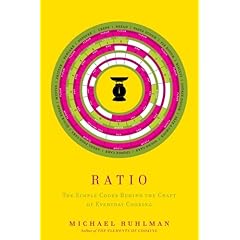
If there is a secret to cooking just about anything, Michael Ruhlman's new book Ratio: The Simple Codes Behind the Craft of Everyday Cooking might have the answer the foodie has been looking for. He sums it up pretty well in this interview with the Globe and Mail.

A ratio is a fixed proportion of ingredients relative to another, and these proportions form the backbone of the culinary arts. A recipe is a specific set of measurements and instructions for combining those measured ingredients. These ratios are starting points.


There are recipes in the book however but Ruhlman is aware of the irony of that. The recipes are very simple and form a basis for more complex recipes. If you know the basic ratio of ingredients (fat, flour and sugar) in a cookie dough, Ruhlman argues that it empowers the cook to create any number cookie recipes.

He also talks about the usefulness of using mass measurements instead of volume. That might explain some of those heavy, dry cakes I've had to suffer through in the past.

It's critical. Ratios don't work with volume, which is why most recipes don't always double well. Flour, depending on the humidity in the air and how long it's been sitting in its sack, weighs anywhere between roughly four and six ounces [per cup]. That means that if a recipe for bread calls for four cups of flour, you could have either sixteen ounces, a pound, or a pound and a half; that's 50 per cent more, and you don't know which one it is. But if you weigh, it's always going to be the same, which is why professional chefs love to use weight.


I've been meaning to buy a scale for some time.

Friday, March 20, 2009

Ingredient Guru: The Bay Scallop

Gordon Ramsay fans and foodies around the world must surely know the Sea Scallop is a popular staple of fine dining around the world. That buttery, savory seafood taste that rolls off the tongue echoes through the palate like a Mozart concerto on a sunny day. It's a staple of most fine dining starter menus and tapas style restaurants in those tres chique parts of town.

But the Sea Scallops retarded younger brother is every bit as tasty, if not smaller, and I think less demanding on the stove. They're smaller but can be stir-fryed in butter and garlic much easier. They cook through much simpler and brown easier. They're great in pasta sauce and even go great in stuffing for chicken and other poultry.

I've tried both but find the bay scallops to be somewhat stronger in flavour. The Atlantic scallops I buy are small about a half an inch wide and are caught off the coast of Cape Breton Island. According to this site there are four distinct species.

One of my favourite recipes is the simplest:

Garlic Penne with Bay Scallops and Snap Peas


Ingredients


2 tbsp butter
1 tsp olive oil
1 garlic clove, minced (substitute 1 tsp of garlic powder)
1 tbsp of thyme leaves
1/2 lb of Bay scallops
1/2 cup each sugar snap peas, green beans, yellow zucchini
300 grams of Penne (or substitute any pasta)
salt and pepper to taste

Directions


1. Boil salted water and add Penne.
1. Heat olive oil and butter in a pan and add garlic over medium-low heat.
2. When the garlic is browned slightly, add teh thyme and the scallops. Saute until the scallops start to turn brown and lose their greyness.
3. Add the vegetables and stir until heated through and the vegetables are slightly tender but still slightly crunchy.
4. Drain the pasta when cooked al dente (or slightly more), and plate with the scallops and vegetables on top.
5. Season to taste.

Saturday, March 14, 2009

Indian Food Made Easy

Here's a television show I wish I could see. Indian food has had a profound effect on British taste buds in the last twenty or so years. I have discovered my love for curry and Indian food which despite its reputation for being exotic and spicy, is as broad and varied as most national cuisines due to the country's size and unique regional cultures. My research for the book led me to appreciate Indian food more and I had included an "Indian Style Vegetable" recipe for that very reason.

The website will give you a good rundown like most BBC food show sites. There are recipes to try and video demonstrations. I also like the glossary. I had forgotten that tandoori meant the oven the food was cooked it.

In the UK, the word tandoori is frequently used to describe food that has been marinated in a spice paste made of ginger, cumin, coriander, paprika, turmeric and cayenne mixed with puréed garlic, puréed ginger, lemon juice, oil and, frequently, yoghurt.


That is also my understanding of the term and how it is used locally.
Speaking of Yoghurt, that's one of the greatest low-fat cream substitutes I've been able to find.

If you're planning on exploring Indian food more closely I recommend you try this page that outlines the essential ingredients. The spices alone should be in every foodie's pantry.

Tuesday, March 3, 2009

I Hate Cilantro too!

If we judge flavour by how edible and/or safe a food is then, Cilantro (or Chinese Parsley or Coriander) has to rank up somewhere in the near-poisonous zone. Turkish delight tastes like soap too, but at least it's sweet.

Now I'm somewhat comforted to learn that there is support for the few of us who would rather do without this garnish menace. Thanks to Larry Moran over at Sandwalk, I've learned there is a website dedicated to putting the hate on this herb from hell.

They have Haikus so you know it must be good:

Sometimes I forget...
Then it rears its ugly stench.
Please, someone kill me.


I will admit that I've used the dried spice version (technically Coriander Seed) as a spice on a few occasions, but the funky taste isn't as dominant and it has a sweeter aftertaste. I've never tasted it alone, so that might explain why I'm less hostile to it.

Some have suggested there might be genetic component involved in the perception of the taste, but it has never been established.

If you don't like the flavour of cilantro, I recommend you substitute Italian leafy parsley in a recipe instead. I've been doing that for some time and get a similar texture with an equally strong and more pleasant flavour.

Update: I just found this great piece in the Wall Street Journal.

At the annual Twins Days Festival in Twinsburg, Ohio, Dr. Wysocki and fellow researchers asked 41 pairs of identical twins and 12 pairs of fraternal twins to rate the "pleasantness" of cilantro. His scale ranged from plus 11 to minus 11, with zero indicating "neither pleasant nor unpleasant." More than 80% of the identical twins gave ratings similar to their siblings, while only 42% of the fraternal twins did -- suggesting cilantro hatred may be a genetic trait. But Dr. Wysocki cautions that he hasn't yet analyzed enough fraternal twins to draw a firm conclusion.

Dr. Wysocki contends dislike of cilantro stems from its odor, not its taste. His hypothesis is that those who don't like it are unable to detect chemicals in the leaf that are pleasing to those who like the herb.


Interesting. Maybe that's why it's fine for me to use coriander seed, unless it's chemically different.