
Sunday, August 31, 2014
Fan Expo 2014
Thanks for everyone who came to visit me at Fan Expo this year. I had a really fun time talking to all the fans and listening to their stories. Please feel free to email me if you have any questions.
There is a lot of fun anecdotes about the book you might be interested in. Doctor Who fans will be interested in the Tom Baker story.
Hope to see you again soon!

Monday, August 27, 2012
Oooh I have a cool new post!


Sunday, October 30, 2011
I'm ready for my closeup
Friday, September 16, 2011
It begins early...
I loved the old show Hilariouis House of Frightenstein when I was a kid. The great Billy Van created all these wonderful characters and you couldn't help but love them all. His characterizations were all spot on and he seemed to be having so much fun with them. I never knew they were all played by one man at the time but even now it's hard to believe that there is one guy under all that makeup. Every performance was exceptionally unique and compelling in its own ways.
I miss Billy Van but I am so glad I got the chance to talk to the man on the phone and tell him how much he meant to my child hood.
It's on Amazon now and well worth the viewing even if you don't have kids.
Grizelda the Ghastly Gourmet was my favourite character. She made cooking look like fun even though the concoctions weren't all that appetizing.
Here's a clip:
I miss Billy Van but I am so glad I got the chance to talk to the man on the phone and tell him how much he meant to my child hood.
It's on Amazon now and well worth the viewing even if you don't have kids.
Grizelda the Ghastly Gourmet was my favourite character. She made cooking look like fun even though the concoctions weren't all that appetizing.
Here's a clip:
Saturday, July 16, 2011
Me at FanExpo in Toronto August 25-28
Hi there. Long time no write. Just a quick note to let you know that I'm going to be appearing as a guest author at FanExpo in Toronto in August. FanExpo is the third largest fan convention in the world. I was shocked to learn that but my good friend James Armstrong who is very busy organizing and putting this together does a great job of creating events for the fans.
Here's my author page at FanExpo
Hope to see you all there. I will have copies to sign and the great Terry Marsh will be there as well signing copies of his artwork.
Here's my author page at FanExpo
Hope to see you all there. I will have copies to sign and the great Terry Marsh will be there as well signing copies of his artwork.
Monday, March 21, 2011
Greetings!
I'm now recuperating from Toronto Comic Con, where Terry Marsh over at Hauntedmarsh.com and I presented the book and some artwork that Terry had done for the book. Terry has some exciting comic stories coming out. Stunted and State51 are certainly worth a look so please head on over there and watch for exciting updates of these two very different stories.
We met a lot of very enthusiastic people and it was great to hear so many different perspectives and viewpoints.
Thanks to all who got a copy and I hope you enjoy this labour of love that's taken us so many years and so much hard work to compile. I'll have photos of the event to post soon
Take care,
Geoff
Sunday, September 19, 2010
Weird Tales from the Book
My cell phone battery died once and upon retrieving my text messages found two messages from:
Once when Gord and I were lining up to meet Angela Cartwright from Lost in Space and Julie Newmar from Batman at a convention, we realized we didn't have any cash to buy their photographs. Luckily, we knew the convention organizer and he gave us cash from my credit card.
Working late trying to get out all our legal permission forms out and we spelt director Richard Fleischer's name wrong. Being a member of Hollywood royalty (his father was one of the original animators) he declined to sign the release form. Gord called him soon after and apologized and he agreed to sign the release.
Roughly 40 per cent of all the names in the book were gleamed from conventions. Travelling to fan conventions from all over, going up to actors, directors and stars and simply asking them "do you cook"? seemed to work best.
The rest of the submissions came from a brute force writing campaign and some helpful assistance from interviewer Tom Weaver and his endless supply of home addresses from stars from the classic period.
For every 18 people we wrote, we received one reply.
Tim Burton's office expressed interest but never got around to sending a submission due to conflicts. Burton's production at the time: Planet of the Apes.
We were turned down by Lou Ferrigno, Douglas Adams, Francis Ford Coppola, George Lucas, Stephen King, Majel Barrett Roddenberry and Jonathan Harris (Lost in Space, A Bugs Life) who asked for money.
Buddy Hackett sent a great Sweet and Sour Salmon recipe but we ended up not including it because he hadn't enough credits. The recipe will be posted on this blog in the near future.
We were originally turned down by Ray Bradbury but Gord sent his dinosaur book and we managed to get a submission.
Tom Baker (Doctor Who) send me a great letter but we couldn't get permission to print it. It has been reproduced on this blog for all to see.
While shovelling snow in the worst snow storm in years, I got a phone call from Jeffery Combs, the star of Re-Animator and one of my favourite actors in the horror genre and we had a great chat. He sent a great recipe for Tortilla Soup. Gord who loved movies of a different generation, had never heard of him. Combs gave away the ending to me of Star Trek Deep Space nine on the phone at a later period.
Gord and I were belonged to different generations. He gathered the older generation and I got recipes from the newer generation of 1970 and beyond.
We gathered over 100 recipes from stars, directors and writers in the horror and SF film genres in the course of 8 years.
Thanks to the sons and daughters and grandsons/daughters of Vincent Price, Alfred Hitchcock, Bela Lugosi, Lon Chaney Jr, Claude Rains,
The Jessica Rains, the daughter of Claude Rains, told me a great story of working with Woody Allen on the set of Sleeper and being taken to see The Invisible Man at the movies in which he wrapped himself up in a scarf to protect his identity and failing miserably thanks to him looking more like his character than he imagined.
After getting a recipe from Joe Dante, we managed to receive a recipe from just about anybody who ever worked with Joe very easily.
I got a phone call from actor Robert Picardo (The Howling, Star Trek Voyager) about his recipe and was delighted that he dedicated it to the Godfather. My mother had answered the phone and thought it was from Patrick Stewart who played Jean-Luc Picard.
Kurtwood Smith sent a nice letter saying he was sorry he "blew it on the cookbook" but we had our deadline moved forward and I wrote him back. I never heard from him again as I had moved after that point but he sent a great photo and I got to tell him how much I enjoyed his performance in Robocop.
Harry Knowles of Aint-it-cool-news fame sent out several emails to his friends and stars regarding the cookbook on our behalf. I received a nice email from Guillermo del Toro saying that he would think about it, but sadly, he never got back to me.
Happily enough, Father Geek (aka Jay Knowles) sent a great recipe he created for the cast of The Faculty which was a great beef brisket he named in honour of Elijah Wood. That recipe is in the book as well and is highly recommended.
Nothing was more exciting about that time of my life than getting a return envelope in the mail with a recipe inside.
Once I received a return envelope with nothing inside. I never figured out who it came from.
Forrey Ackerman (the agent and super fan) sent a ton of anecdotes and most of them are in the book. I enjoyed talking to him on the phone and he shared many more.
- Bruce Campbell, indie-god of horror and awesomeness leaving me a message about our disclaimer form.
- Richard Matheson: author-god of such books as I am Legend and many short stories and original Twilight Zone episodes leaving a message forgetting what he sent us.
Once when Gord and I were lining up to meet Angela Cartwright from Lost in Space and Julie Newmar from Batman at a convention, we realized we didn't have any cash to buy their photographs. Luckily, we knew the convention organizer and he gave us cash from my credit card.
Working late trying to get out all our legal permission forms out and we spelt director Richard Fleischer's name wrong. Being a member of Hollywood royalty (his father was one of the original animators) he declined to sign the release form. Gord called him soon after and apologized and he agreed to sign the release.
Roughly 40 per cent of all the names in the book were gleamed from conventions. Travelling to fan conventions from all over, going up to actors, directors and stars and simply asking them "do you cook"? seemed to work best.
The rest of the submissions came from a brute force writing campaign and some helpful assistance from interviewer Tom Weaver and his endless supply of home addresses from stars from the classic period.
For every 18 people we wrote, we received one reply.
Tim Burton's office expressed interest but never got around to sending a submission due to conflicts. Burton's production at the time: Planet of the Apes.
We were turned down by Lou Ferrigno, Douglas Adams, Francis Ford Coppola, George Lucas, Stephen King, Majel Barrett Roddenberry and Jonathan Harris (Lost in Space, A Bugs Life) who asked for money.
Buddy Hackett sent a great Sweet and Sour Salmon recipe but we ended up not including it because he hadn't enough credits. The recipe will be posted on this blog in the near future.
We were originally turned down by Ray Bradbury but Gord sent his dinosaur book and we managed to get a submission.
Tom Baker (Doctor Who) send me a great letter but we couldn't get permission to print it. It has been reproduced on this blog for all to see.
While shovelling snow in the worst snow storm in years, I got a phone call from Jeffery Combs, the star of Re-Animator and one of my favourite actors in the horror genre and we had a great chat. He sent a great recipe for Tortilla Soup. Gord who loved movies of a different generation, had never heard of him. Combs gave away the ending to me of Star Trek Deep Space nine on the phone at a later period.
Gord and I were belonged to different generations. He gathered the older generation and I got recipes from the newer generation of 1970 and beyond.
We gathered over 100 recipes from stars, directors and writers in the horror and SF film genres in the course of 8 years.
Thanks to the sons and daughters and grandsons/daughters of Vincent Price, Alfred Hitchcock, Bela Lugosi, Lon Chaney Jr, Claude Rains,
The Jessica Rains, the daughter of Claude Rains, told me a great story of working with Woody Allen on the set of Sleeper and being taken to see The Invisible Man at the movies in which he wrapped himself up in a scarf to protect his identity and failing miserably thanks to him looking more like his character than he imagined.
After getting a recipe from Joe Dante, we managed to receive a recipe from just about anybody who ever worked with Joe very easily.
I got a phone call from actor Robert Picardo (The Howling, Star Trek Voyager) about his recipe and was delighted that he dedicated it to the Godfather. My mother had answered the phone and thought it was from Patrick Stewart who played Jean-Luc Picard.
Kurtwood Smith sent a nice letter saying he was sorry he "blew it on the cookbook" but we had our deadline moved forward and I wrote him back. I never heard from him again as I had moved after that point but he sent a great photo and I got to tell him how much I enjoyed his performance in Robocop.
Harry Knowles of Aint-it-cool-news fame sent out several emails to his friends and stars regarding the cookbook on our behalf. I received a nice email from Guillermo del Toro saying that he would think about it, but sadly, he never got back to me.
Happily enough, Father Geek (aka Jay Knowles) sent a great recipe he created for the cast of The Faculty which was a great beef brisket he named in honour of Elijah Wood. That recipe is in the book as well and is highly recommended.
Nothing was more exciting about that time of my life than getting a return envelope in the mail with a recipe inside.
Once I received a return envelope with nothing inside. I never figured out who it came from.
Forrey Ackerman (the agent and super fan) sent a ton of anecdotes and most of them are in the book. I enjoyed talking to him on the phone and he shared many more.
Friday, August 27, 2010
Home made Corn Dogs

I was getting somewhat annoyed at having cornmeal lying around the cupboard and not having a proper use for it since I stopped making cornbread with it. Too dry. I've since substituted creamed corn for that so this seemed like the best use of it.
Ingredients
1 cup all-purpose flour1 cup yellow cornmeal
1 tablespoon granulated sugar
3 teaspoons baking powder
1 teaspoon salt
1 1/2 teaspoons cayenne pepper
2 eggs
1 cup milk
1/4 cup canola oil
2 tablespoons of bacon fat or duck fat
oil or shortening for deep frying
10-12 hot dogs
wooden skewers or popsicle sticks
Directions:
Heat the oil in the deep fryer until it's 360°.
Combine the flour, cornmeal, sugar, baking powder, salt, bacon fat and cayenne pepper with a fork in a medium sized mixing bowl.
In a smaller bowl, beat the eggs with milk and the 1/4 cup of oil. Stir egg and milk mixture into dry ingredients and mix until the batter is fairly smooth and consistent.
Pour the batter into a tall glass. A beer glass works best.
Pat each hot dog/wiener with a paper towel to ensure it's fairly dry.
Insert a wooden skewers (I used 2 for each wiener) or Popsicle stick into each wiener. Holding the stick or skewer, dip each hot dog into the beer glass filled batter, twisting the wiener to coat evenly so that the batter is relatively thick.
Cook hot dogs in several batches of about 2 or three each until golden brown (about 2-3 minutes). Place on paper towels to drain.
Monday, May 31, 2010
Cooking a well done steak Gordon Ramsay
I found this video on Youtube and thought it was interesting. A news crew went to Gordon Ramsay's Maze restaurant and filmed a well done steak that was "overdone and a bit burnt" and tasted like "rubber."
In other words, it sounds like just about every well done steak I've ever had.
I think the journalists were a bit obnoxious, and I have to side with Ramsay on this one. Either they have an axe to grind with Ramsay, or they're fishing for more ratings. In any event, a well done steak loses its flavour through cooking.
Typically, well done steaks will be slightly charred on the outside, especially if it's a thick steak that the longer cooking requires. An overcooked steak will be bitter. I'm not sure what rubber tastes like as unlike the reviewer, ever eaten it but I going to assume he's referring to the chewy texture.
However, the USDA minimum safe temperature for cuts of steak are 145F which is around Medium to Medium well done so a well done steak is not necessary for safety reasons. Red meat turns pink at around 140F as the myoglobin -- a protein that stores and carries oxygen to the muscle tissue -- starts to turn colour. It's also that runny red juice that people mistake for blood. It's actually the myoglobin that gives the meat its red colour.
Some tips for cooking steak:
In other words, it sounds like just about every well done steak I've ever had.
I think the journalists were a bit obnoxious, and I have to side with Ramsay on this one. Either they have an axe to grind with Ramsay, or they're fishing for more ratings. In any event, a well done steak loses its flavour through cooking.
Typically, well done steaks will be slightly charred on the outside, especially if it's a thick steak that the longer cooking requires. An overcooked steak will be bitter. I'm not sure what rubber tastes like as unlike the reviewer, ever eaten it but I going to assume he's referring to the chewy texture.
However, the USDA minimum safe temperature for cuts of steak are 145F which is around Medium to Medium well done so a well done steak is not necessary for safety reasons. Red meat turns pink at around 140F as the myoglobin -- a protein that stores and carries oxygen to the muscle tissue -- starts to turn colour. It's also that runny red juice that people mistake for blood. It's actually the myoglobin that gives the meat its red colour.
Some tips for cooking steak:
- Don't go by weight when cooking meat. Use the thickness as a measure instead. A one inch thick steak will cook on medium heat for 4 minutes a side for rare, 5-6 for medium and around 7 for well done.
- Only turn steaks once especially if using a BBQ. If turned too early, the outer layer can stick to the grill and you want to get those great lines on the steak.
- Meat is mostly water and they give it up through the cooking process. Let the meat rest for about 10 minutes so it can reabsorb the water and you'll end up with a more tender steak.
- When taking temperatures, use the center of the meat away from the bone (the bone can heat up more than the meat and give an inaccurate temperature reading) and slowly pull out the thermometer reading the temperature the entire time. The lowest temperature will be the most accurate.
- Ground meat should be cooked to 155F at least. There is greater danger for pathogens and fecal bacteria from the intestines in the butchering process with ground cuts of meat.
- Chefs often fry their steaks in butter with a bit of olive oil and keep basting through the cooking process. Tilt the pan slightly towards you and with a soup spoon, keep pouring the butter over the top. This will result in a juicier steak even at medium.
Friday, May 21, 2010
Does 'searing' meat seal in the juices?
I know it's been a while, but I'm returning to the blog because I've started cooking again after a long contract. I dug out this old post I wrote two years ago and made some changes to it.
This is a somewhat old question now but I thought I would revisit it because there is still a great deal of confusion on the topic. I still see people doing this and for the wrong reason. It seems to depend on what one means by 'searing'. That does not mean preventing a complete net water loss from the meat tissue.
In fact, searing the meat results in a greater loss of water content from the muscle tissue than not searing the meat. As the meat is applied to a very hot surface, it browns the outer tissue and purportedly reduces the porousness of the muscle fibres, a belief that, according to Wikipedia, began with a food scientist and chemist Justus von Liebig in 1850.
The hard crusty outer layer of that is formed through a chemical process is often falsely believed to act as a barrier to prevent water from escaping during the cooking process.
Searing a piece of meat improves the flavour through a chemical process called The Maillard reaction. Unlike caramelisation in which sugars are oxidized, The Maillard reaction is a process where a carbon and oxygen group of a sugar reacts with an amino group from an amino acid which results in a browning effect and a flavour change. A good example is the toasting of bread or roasting of coffee.
It does improve the texture as the difference between a crusty exterior and a softer interior make for a more desirable palate experience. Quite often chefs will brown the exterior of the meat before broiling, frying or even boiling large roasts.
Sear the meat to improve the flavour, but a juicy cut of meat on the table starts with a fresh cut of meat from the local butcher.
For more information on the science of cooking, try On Food and Cooking: The Science and Lore of the Kitchen by Harold McGee and Molecular Gastronomy: Exploring the Science of Flavor by Herve This.
This is a somewhat old question now but I thought I would revisit it because there is still a great deal of confusion on the topic. I still see people doing this and for the wrong reason. It seems to depend on what one means by 'searing'. That does not mean preventing a complete net water loss from the meat tissue.
In fact, searing the meat results in a greater loss of water content from the muscle tissue than not searing the meat. As the meat is applied to a very hot surface, it browns the outer tissue and purportedly reduces the porousness of the muscle fibres, a belief that, according to Wikipedia, began with a food scientist and chemist Justus von Liebig in 1850.
The hard crusty outer layer of that is formed through a chemical process is often falsely believed to act as a barrier to prevent water from escaping during the cooking process.
Searing a piece of meat improves the flavour through a chemical process called The Maillard reaction. Unlike caramelisation in which sugars are oxidized, The Maillard reaction is a process where a carbon and oxygen group of a sugar reacts with an amino group from an amino acid which results in a browning effect and a flavour change. A good example is the toasting of bread or roasting of coffee.
It does improve the texture as the difference between a crusty exterior and a softer interior make for a more desirable palate experience. Quite often chefs will brown the exterior of the meat before broiling, frying or even boiling large roasts.
Sear the meat to improve the flavour, but a juicy cut of meat on the table starts with a fresh cut of meat from the local butcher.
For more information on the science of cooking, try On Food and Cooking: The Science and Lore of the Kitchen by Harold McGee and Molecular Gastronomy: Exploring the Science of Flavor by Herve This.
Wednesday, May 19, 2010
Tuesday, August 11, 2009
Screw Cork! Caps work just as well!
I may be a snob about a few things (movies in particular) but wine isn't one of them. The science is in regarding the cap vs. cork debate on wine and it's clear that the cap works just as well but adds convenience.
Globe and Mail wine connoisseur and fellow alcohol snob Beppi Crosariol agrees with me.
He writes:
So why use cork? Partially I think it's part of the experience. Searching through the kitchen drawers for a corkscrew and fumbling to stick it through the cork and turn against mounting resistance seems to make the effort of enjoying the wine more pleasurable but only in the way being made to wear a toga and ceremoniously dunked with maple syrup is tantamount to entering high school.
Let's hear it for TCA less wine. I love progress.
Globe and Mail wine connoisseur and fellow alcohol snob Beppi Crosariol agrees with me.
He writes:
Some avid wine drinkers know – and too many do not – that cork is highly susceptible to a foul-smelling but otherwise harmless defect commonly known as cork taint. Officially called 2,4,6-trichloroanisole, it is not to be confused with those little particles falling into the bottle as you wrestle with a dried-out cork. TCA is a specific chemical fault and it smells, depending on whom you consult, like mouldy cardboard, damp newspapers, sweaty socks or my neighbour's unwashed dog in the rain.
So why use cork? Partially I think it's part of the experience. Searching through the kitchen drawers for a corkscrew and fumbling to stick it through the cork and turn against mounting resistance seems to make the effort of enjoying the wine more pleasurable but only in the way being made to wear a toga and ceremoniously dunked with maple syrup is tantamount to entering high school.
Let's hear it for TCA less wine. I love progress.
Friday, June 19, 2009

Thursday, June 18, 2009
A curious letter from Doctor Who
This is a letter I received from Tom Baker about ten years ago when I first started working on the cookbook (not a typo -- it's really been that long) It didn't make it in the book because I didn't know quite what to do with it and I never got written permission to use it. I do think this blog is a good place to put it and it's a shame to go to waste. It is pretty entertaining and I hope more people can make sense of it than me.
I asked Mr. Baker if he could give me a recipe, his favourite foods or an anecdote.
This is what I got:
To begin at the beginning. I was born with several teeth on the 20th Jan. 1934. I mention the teeth not to brag but to praise my mother who adored me and told me that she went through hell for the first few hours of my life. Not only did I seem glad to be out of the womb and into the Liverpool air, but I was simply an ecstatic and voracious feeder; which I still am. Or, if you like, which is still true.
My darling mother told me that me appetite, like my acting was way over the top of anything she could imagine. And so sharp were my teeth that I made mince meat of my mother's nipples. I waited till she died before I revealed this piece of autobiography. Of course these are very dim memories for me.
Because the tooth fairy had been so good to me I was deprived of my mother's molk within three hours of my attack on her nipples; both of them. I hope it's clear that I'm talking about both my mother's nipples and not the nipples of the tooth fiary for whom I have the greatest respect. My mohter was a martyr to her love for me.
Oh, get on with it, Tom.
So there you have the beginning of my eating experience, my own mother!
I'll give you a piece of advice here; never trust a man who would eat his own mother.
My mother also told me that the Germans had heard about me and that's why they declared war on Liverpool and began to bomb us so often. I had no idea that they were also attacking the rest of the country. So within a short time the country was short of food, all my fault, and then began the austerity programme. Each day at six o'clock in the morning and then at midday and again at six at night a large wooden spoon was produced from behind the oven and I was fed cod liver oil. In no time I was hooked and would mew for my CLO.
We also were fed a nice looking asphalt like substance called malt. I grew to like this as much as my thrice daily CLO. Whatever these aids to life contained they sure made me grow. By the time I was six years old I was bout five feet and eight inches tall and often topped in the street by recruiting sergeants with gruff voices who demanded to know why I was not in the army. When they discovered I was only six and not eighteen they whistled Rule Britannia and marvelled.
About this time, 1940, I started on a course to become a professional liar. We were keen Roman Catholics in my bit of Liverpool and confession was a must if you were interested in Eternal life. Following this sacrament, I made my first communion. For the Jews, Muslims, Buddhists and Nudists among your readers I should explain.
This second steop on teh way to perfection was called: "First Holy Communion," and it was a very special morning indeed. IN fact it was the most amazing morning of my entire life. It was the mornign of the day that I ate God. Shall I say that again? OK. It was the morning of the day that I first ate God. I swallowed His body, His blood, His Soul and His Divinity. It really was a big day for me. I should add for those of you who like all the details that I did not bite Him nor did I chew Him.
No, He was so tender that He just dissolved on my tongue and I ingested Him. It was my first meal on that glorious May morning 1940.
So, to recap: My first meal was milk and both my mother's nipples. This was followed by a mixture called Cow and Gate. This was a white paste, I think, that tasted vaguely of cows and I don't (know) what else. But it was a great fertilizer and made babies grow tall. Then came the Malt and the Cod Liver Oil on top of the Cow and Gate. And then, as I have just told you, I started to eat God.
Well this mixture acted like magic and I grew like a beanstalk in a Pantomime. By the time I was eight I was as tall as a Grenadier guardsman though of course much thinner. I was called lofty by any passer by.
Then came Bovril, which is an essence of beef. Taken in large quantities with say spinach seems to produce a state of credulousness that surpasses disbelief. So Nipples Blood God and Spinach were my early influences. You can imagine the exquisite sense of anticipation I feel in a restaurant when I ask the waiter to bring the Menu! But I'm always disappointed. If it wasn't for the Spinach, I'd be in despair.
I asked Mr. Baker if he could give me a recipe, his favourite foods or an anecdote.
This is what I got:
To begin at the beginning. I was born with several teeth on the 20th Jan. 1934. I mention the teeth not to brag but to praise my mother who adored me and told me that she went through hell for the first few hours of my life. Not only did I seem glad to be out of the womb and into the Liverpool air, but I was simply an ecstatic and voracious feeder; which I still am. Or, if you like, which is still true.
My darling mother told me that me appetite, like my acting was way over the top of anything she could imagine. And so sharp were my teeth that I made mince meat of my mother's nipples. I waited till she died before I revealed this piece of autobiography. Of course these are very dim memories for me.
Because the tooth fairy had been so good to me I was deprived of my mother's molk within three hours of my attack on her nipples; both of them. I hope it's clear that I'm talking about both my mother's nipples and not the nipples of the tooth fiary for whom I have the greatest respect. My mohter was a martyr to her love for me.
Oh, get on with it, Tom.
So there you have the beginning of my eating experience, my own mother!
I'll give you a piece of advice here; never trust a man who would eat his own mother.
My mother also told me that the Germans had heard about me and that's why they declared war on Liverpool and began to bomb us so often. I had no idea that they were also attacking the rest of the country. So within a short time the country was short of food, all my fault, and then began the austerity programme. Each day at six o'clock in the morning and then at midday and again at six at night a large wooden spoon was produced from behind the oven and I was fed cod liver oil. In no time I was hooked and would mew for my CLO.
We also were fed a nice looking asphalt like substance called malt. I grew to like this as much as my thrice daily CLO. Whatever these aids to life contained they sure made me grow. By the time I was six years old I was bout five feet and eight inches tall and often topped in the street by recruiting sergeants with gruff voices who demanded to know why I was not in the army. When they discovered I was only six and not eighteen they whistled Rule Britannia and marvelled.
About this time, 1940, I started on a course to become a professional liar. We were keen Roman Catholics in my bit of Liverpool and confession was a must if you were interested in Eternal life. Following this sacrament, I made my first communion. For the Jews, Muslims, Buddhists and Nudists among your readers I should explain.
This second steop on teh way to perfection was called: "First Holy Communion," and it was a very special morning indeed. IN fact it was the most amazing morning of my entire life. It was the mornign of the day that I ate God. Shall I say that again? OK. It was the morning of the day that I first ate God. I swallowed His body, His blood, His Soul and His Divinity. It really was a big day for me. I should add for those of you who like all the details that I did not bite Him nor did I chew Him.
No, He was so tender that He just dissolved on my tongue and I ingested Him. It was my first meal on that glorious May morning 1940.
So, to recap: My first meal was milk and both my mother's nipples. This was followed by a mixture called Cow and Gate. This was a white paste, I think, that tasted vaguely of cows and I don't (know) what else. But it was a great fertilizer and made babies grow tall. Then came the Malt and the Cod Liver Oil on top of the Cow and Gate. And then, as I have just told you, I started to eat God.
Well this mixture acted like magic and I grew like a beanstalk in a Pantomime. By the time I was eight I was as tall as a Grenadier guardsman though of course much thinner. I was called lofty by any passer by.
Then came Bovril, which is an essence of beef. Taken in large quantities with say spinach seems to produce a state of credulousness that surpasses disbelief. So Nipples Blood God and Spinach were my early influences. You can imagine the exquisite sense of anticipation I feel in a restaurant when I ask the waiter to bring the Menu! But I'm always disappointed. If it wasn't for the Spinach, I'd be in despair.
Wednesday, June 17, 2009
Don't chop those carrots!

Chopping carrots was always a bit of a chore, but I never knew there were drawbacks to both health and taste. BBC News has released this story Cancer boost from whole carrots and the findings are
Scientists found "boiled before cut" carrots contained 25% more of the anti-cancer compound falcarinol than those chopped up first.
Experiments on rats fed falcarinol have shown they develop fewer tumours.
The Newcastle University study will be presented at NutrEvent, a conference on nutrition and health, to be held in France.
Lead researcher Dr Kirsten Brandt, from Newcastle University's School of Agriculture, Food and Rural Development, said: "Chopping up your carrots increases the surface area so more of the nutrients leach out into the water while they are cooked.
"By keeping them whole and chopping them up afterwards you are locking in nutrients and the taste, so the carrot is better for you all round."
The Newcastle scientist, along with colleagues at the University of Denmark, discovered the health benefits of falcarinol in carrots four years ago.
Lead researcher Dr Kirsten Brandt, from Newcastle University's School of Agriculture, Food and Rural Development, said: "Chopping up your carrots increases the surface area so more of the nutrients leach out into the water while they are cooked.
Twenty five percent is a pretty significant difference especially considering a reduction in tumors by a third for rats. I'm not sure what the comparison for humans is and what exactly type of cancer it would affect but so far this is only one study and hopefully there will be more to come
From a pure culinary perspective, I think just as many restaurants will find this interesting:
Dr Brandt added that in blind taste studies the whole carrots also tasted much better.
Eight of ten people favoured the whole vegetables over those that were pre-chopped.
This is because the naturally occurring sugars which are responsible for giving the carrot its distinctively sweet flavour were also found in higher concentrations in the carrot that had been cooked whole.
Huh.
Monday, April 13, 2009
Home Made Chicken Noodle Soup
 This is a home made chicken soup recipe I came up with in honour of dear friend, fellow browncoat, Jewish
 Nothing quite soothes quite like a chicken soup and for once, I even made the stock myself. One can learn a lot about cooking just by walking through the grocery store in search of nothing in particular. I love not having to look at a list and wondering which isle I should head to next. Some of the most interesting things have come from just wondering what to do with a particular ingredient I've never had before. Hopefully, I'll find some use for that dragon fruit but in the meantime, I was elated to come across a hoard of freshly wrapped stock chicken bones.
Cheap too. That's the important part, especially in this day and age and the soup has lasted me over a week infusing me with protein and vegetable nutrients.
 Oddly enough, one of my early influences in cooking was Bugs Bunny cartoons. For some reason, Bugs was always to be the main ingredient of a soup. Perhaps the act of chopping up ingredients and throwing ingredients in a big pot provided more comedic fodder, but the message was that soups are pretty easy to make.
A chicken soup needn't be complicated. In fact, the simpler the soup, the better and you'll be more inclined to make them more which is the same mistake people with crock pots make. I think it's important to use home made chicken stock (not broth -- which isn't as tasty), and healthier too as there is less sodium.
And it's low in fat and cholesterol and rabbit friendly of course...
So here's the recipe:
The Stock:
It's Gordon Ramsay's actually so I'll summarize it here as it's quite simple. It makes about six cups.
Ingredients
(my comments are in italics)
2 tbsp olive oil
1 carrot, peeled and chopped
1 onion, peeled and chopped (I used 2 shallots, tasted better)
2 celery sticks, chopped (I used three, It tastes better and makes the soup a bit crunchier)
1 leek, washed and sliced (make sure to get plenty of the green bits. That's where the flavour lives)
1 bay leaf
1 thyme spring
3 garlic cloves, peeled (I smashed them a bit. The flavour gets out better)
2 tbsp tomato paste
2 tbsp flour
2 lb raw chicken bones (I doubled this and some of the bones had some meat on them. Chicken backs are preferable to legs and wing bones)
sea salt and black pepper
1. Heat olive oil in stock pot and add vegetables, herbs, and garlic. Cook until golden over medium heat stirring occasionally.
2. Stir in paste and flour and cook another minute.
3. Add bones and pour in enough cold water to cover.
4. Season and bring to a boil.
5. Skim off any scum that rises to the surface.
6. Reduce heat and let simmer gently for one hour.
7. Let the stock stand for a few minutes, then pass through a fine strainer and let cool.
Refrigerate and use within five days or freeze for up to three months.
The Soup
6 cups of stock (above)
1 chicken breast
1 onion, chopped
1 carrot, chopped
1 leek, chopped
2 celery ribs, chopped
1 handful of egg noodles, fine (important to have the fine ones)
1/2 tsp thyme, dried
1/2 tsp basil, dried
1 garlic clove, chopped finely
1 small handful of fine egg noodles.
Directions
1. Heat stock in pot and bring to a boil.
2. Add chicken breast, carrot, leek, onion, celery, garlic and herbs and simmer for one hour. Add more water if necessary.
3. Remove chicken breast and chop into bite sized chunks. Return to pot.
4. Add noodles and simmer until they are soft.
5. Season with salt and pepper and serve.
Food Price Hikes
The BBC reports that food prices are going up which is not suprising. This is bad news on many levels, because most of the cheapest foods available, are high in sodium, fat and calories. It is for the most part, easier to keep prices down that way. It's not made any easier when the cheapest cut of meat is the hot dog.
Let's face it, we can't all make the most of rice and beans which are healthy for the price but hardly exciting.
They report the following price increases:
Well so much for Rice being cheap, so that just leaves the beans. I firmly believe that culinary education is the key here and people all over the world, including Britain, have forgotten how to cook.
Gordon Ramsay has done a good job at educating the public in England and here in Canada we have some pretty smart home grown chefs on the Food Network, but it's not enough. A little patience, imagination and I think above all, planning menus and shopping lists but we're not used to doing that.
Thankfully the web is making it easier to save money more than ever. Sites like Frugal Shopper and other various articles onsaving money have made an impact on every day budget cuts in grocery bills.
Just remember, fresh is better than dried but anything is better and cheaper than what comes in a frozen box. Consider a lasagna, and add up the costs. A box of frozen lasagna that costs $2.39 will be far more expensive than a large lasagna you make yourself and cut up into lunch sized portions. Price reduced warehouses don't necessarily have cheaper ingredients. Some of these places hike up the prices on some ingredients (meats or vegetables) to compensate. It's always good to compare prices. Years of experience in retail has taught me the value of knowing what the competitor values as their core customer expectation and how to compete with that.
Do the math. Fresh is cheaper than frozen and store bought. It might take a little more effort and time but it's worth it. Those lunches at work add up and you'll lose weight with less added sugar, fats and carbohydrates.
Work up a timetable during weekends. Freeze what you can, prepare ahead, clip coupons, price check and you'll be on the road to a healthier bank account and waist line.
Let's face it, we can't all make the most of rice and beans which are healthy for the price but hardly exciting.
They report the following price increases:
Rice - up 81%
Pork sausages - up 51%
Mince - up 22%
Milk - up 14%
Well so much for Rice being cheap, so that just leaves the beans. I firmly believe that culinary education is the key here and people all over the world, including Britain, have forgotten how to cook.
Gordon Ramsay has done a good job at educating the public in England and here in Canada we have some pretty smart home grown chefs on the Food Network, but it's not enough. A little patience, imagination and I think above all, planning menus and shopping lists but we're not used to doing that.
Thankfully the web is making it easier to save money more than ever. Sites like Frugal Shopper and other various articles onsaving money have made an impact on every day budget cuts in grocery bills.
Just remember, fresh is better than dried but anything is better and cheaper than what comes in a frozen box. Consider a lasagna, and add up the costs. A box of frozen lasagna that costs $2.39 will be far more expensive than a large lasagna you make yourself and cut up into lunch sized portions. Price reduced warehouses don't necessarily have cheaper ingredients. Some of these places hike up the prices on some ingredients (meats or vegetables) to compensate. It's always good to compare prices. Years of experience in retail has taught me the value of knowing what the competitor values as their core customer expectation and how to compete with that.
Do the math. Fresh is cheaper than frozen and store bought. It might take a little more effort and time but it's worth it. Those lunches at work add up and you'll lose weight with less added sugar, fats and carbohydrates.
Work up a timetable during weekends. Freeze what you can, prepare ahead, clip coupons, price check and you'll be on the road to a healthier bank account and waist line.
Wednesday, April 8, 2009
It's ratio, not recipe
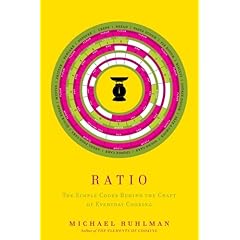
If there is a secret to cooking just about anything, Michael Ruhlman's new book Ratio: The Simple Codes Behind the Craft of Everyday Cooking might have the answer the foodie has been looking for. He sums it up pretty well in this interview with the Globe and Mail.
A ratio is a fixed proportion of ingredients relative to another, and these proportions form the backbone of the culinary arts. A recipe is a specific set of measurements and instructions for combining those measured ingredients. These ratios are starting points.
There are recipes in the book however but Ruhlman is aware of the irony of that. The recipes are very simple and form a basis for more complex recipes. If you know the basic ratio of ingredients (fat, flour and sugar) in a cookie dough, Ruhlman argues that it empowers the cook to create any number cookie recipes.
He also talks about the usefulness of using mass measurements instead of volume. That might explain some of those heavy, dry cakes I've had to suffer through in the past.
It's critical. Ratios don't work with volume, which is why most recipes don't always double well. Flour, depending on the humidity in the air and how long it's been sitting in its sack, weighs anywhere between roughly four and six ounces [per cup]. That means that if a recipe for bread calls for four cups of flour, you could have either sixteen ounces, a pound, or a pound and a half; that's 50 per cent more, and you don't know which one it is. But if you weigh, it's always going to be the same, which is why professional chefs love to use weight.
I've been meaning to buy a scale for some time.
Friday, March 20, 2009
Ingredient Guru: The Bay Scallop
Gordon Ramsay fans and foodies around the world must surely know the Sea Scallop is a popular staple of fine dining around the world. That buttery, savory seafood taste that rolls off the tongue echoes through the palate like a Mozart concerto on a sunny day. It's a staple of most fine dining starter menus and tapas style restaurants in those tres chique parts of town.
But the Sea Scallops retarded younger brother is every bit as tasty, if not smaller, and I think less demanding on the stove. They're smaller but can be stir-fryed in butter and garlic much easier. They cook through much simpler and brown easier. They're great in pasta sauce and even go great in stuffing for chicken and other poultry.
I've tried both but find the bay scallops to be somewhat stronger in flavour. The Atlantic scallops I buy are small about a half an inch wide and are caught off the coast of Cape Breton Island. According to this site there are four distinct species.
One of my favourite recipes is the simplest:
2 tbsp butter
1 tsp olive oil
1 garlic clove, minced (substitute 1 tsp of garlic powder)
1 tbsp of thyme leaves
1/2 lb of Bay scallops
1/2 cup each sugar snap peas, green beans, yellow zucchini
300 grams of Penne (or substitute any pasta)
salt and pepper to taste
1. Boil salted water and add Penne.
1. Heat olive oil and butter in a pan and add garlic over medium-low heat.
2. When the garlic is browned slightly, add teh thyme and the scallops. Saute until the scallops start to turn brown and lose their greyness.
3. Add the vegetables and stir until heated through and the vegetables are slightly tender but still slightly crunchy.
4. Drain the pasta when cooked al dente (or slightly more), and plate with the scallops and vegetables on top.
5. Season to taste.
But the Sea Scallops retarded younger brother is every bit as tasty, if not smaller, and I think less demanding on the stove. They're smaller but can be stir-fryed in butter and garlic much easier. They cook through much simpler and brown easier. They're great in pasta sauce and even go great in stuffing for chicken and other poultry.
I've tried both but find the bay scallops to be somewhat stronger in flavour. The Atlantic scallops I buy are small about a half an inch wide and are caught off the coast of Cape Breton Island. According to this site there are four distinct species.
One of my favourite recipes is the simplest:
Garlic Penne with Bay Scallops and Snap Peas
Ingredients
2 tbsp butter
1 tsp olive oil
1 garlic clove, minced (substitute 1 tsp of garlic powder)
1 tbsp of thyme leaves
1/2 lb of Bay scallops
1/2 cup each sugar snap peas, green beans, yellow zucchini
300 grams of Penne (or substitute any pasta)
salt and pepper to taste
Directions
1. Boil salted water and add Penne.
1. Heat olive oil and butter in a pan and add garlic over medium-low heat.
2. When the garlic is browned slightly, add teh thyme and the scallops. Saute until the scallops start to turn brown and lose their greyness.
3. Add the vegetables and stir until heated through and the vegetables are slightly tender but still slightly crunchy.
4. Drain the pasta when cooked al dente (or slightly more), and plate with the scallops and vegetables on top.
5. Season to taste.
Saturday, March 14, 2009
Indian Food Made Easy
Here's a television show I wish I could see. Indian food has had a profound effect on British taste buds in the last twenty or so years. I have discovered my love for curry and Indian food which despite its reputation for being exotic and spicy, is as broad and varied as most national cuisines due to the country's size and unique regional cultures. My research for the book led me to appreciate Indian food more and I had included an "Indian Style Vegetable" recipe for that very reason.
The website will give you a good rundown like most BBC food show sites. There are recipes to try and video demonstrations. I also like the glossary. I had forgotten that tandoori meant the oven the food was cooked it.
That is also my understanding of the term and how it is used locally.
Speaking of Yoghurt, that's one of the greatest low-fat cream substitutes I've been able to find.
If you're planning on exploring Indian food more closely I recommend you try this page that outlines the essential ingredients. The spices alone should be in every foodie's pantry.
The website will give you a good rundown like most BBC food show sites. There are recipes to try and video demonstrations. I also like the glossary. I had forgotten that tandoori meant the oven the food was cooked it.
In the UK, the word tandoori is frequently used to describe food that has been marinated in a spice paste made of ginger, cumin, coriander, paprika, turmeric and cayenne mixed with puréed garlic, puréed ginger, lemon juice, oil and, frequently, yoghurt.
That is also my understanding of the term and how it is used locally.
Speaking of Yoghurt, that's one of the greatest low-fat cream substitutes I've been able to find.
If you're planning on exploring Indian food more closely I recommend you try this page that outlines the essential ingredients. The spices alone should be in every foodie's pantry.
Subscribe to:
Posts (Atom)


